
The map pack you're optimising for is being replaced in some searches
Before the tactics, something that changes how you should read every other Google Maps SEO guide published before this year.
Since late 2025, Google has been replacing the traditional three-business local pack with an AI-generated local pack on a growing share of searches. Not pushing it down the page — replacing it. Local SEO specialist Joy Hawkins documented it from December 2025, and Places Scout data put it at roughly 8% of keywords and rising.
The practical effects reported so far: AI local packs often show one or two businesses instead of three, many lack call buttons, and some businesses have seen visibility drops of 50% or more on affected queries.
That doesn't make Google Maps SEO pointless — around 92% of local searches still show the normal pack, and the AI version still has to pick businesses from somewhere. But it does mean two things:
- Fewer slots. If a three-slot pack becomes a two-slot pack, being fourth was already bad and being third is now bad too.
- Your profile is now an input to a generated answer, not just a listing someone reads. Completeness matters more than presentation.
Keep that in mind throughout.
What Google itself says: the three factors behind Google Maps SEO
Every Google Maps SEO tactic worth doing traces back to one of three factors, and Google publishes them itself:

Google Business Profile Help, "Tips to improve your local ranking on Google"
Three things worth pulling out.
"There's no way to request or pay for a better local ranking on Google." Worth knowing when an agency offers guaranteed map pack placement, or when a caller claims your listing will be removed unless you pay. Both are common and both are false.
"Local results are mainly based on relevance, distance, and popularity." Three factors, and they behave very differently from one another.
Relevance — how well your profile matches the search. This is where optimization work lives.
Distance — how far you are from the searcher. The strongest single factor and the one you cannot change.
Prominence — how well known you are. Reviews, links, real-world recognition. Slow to build, impossible to shortcut.
What the Google Maps SEO weightings look like
Google doesn't publish weights. Industry surveys of local SEO practitioners estimate them, and the 2026 figures land about here for the local pack:
| Signal | Weight |
|---|---|
| Google Business Profile signals | 32% |
| Review signals | 20% |
| On-page signals | 15% |
| Behavioural signals | 9% |
| Link signals | 8% |
| Citation signals | 6% |
| Personalisation | 6% |
| Social signals | 4% |
Treat these as a guide to where effort pays, not as physics. They're aggregated expert opinion about Google Maps SEO, not leaked algorithm documentation.
The useful reading: your profile and your reviews are over half of it. Citations — the directory listings that local SEO packages have sold for fifteen years — are 6%. If someone is charging you monthly for citation building and nothing else, that's where their effort is going.
Why you don't have "a ranking" in Google Maps
The most common question in local SEO is "why do I rank third from my office but nowhere from across town?"
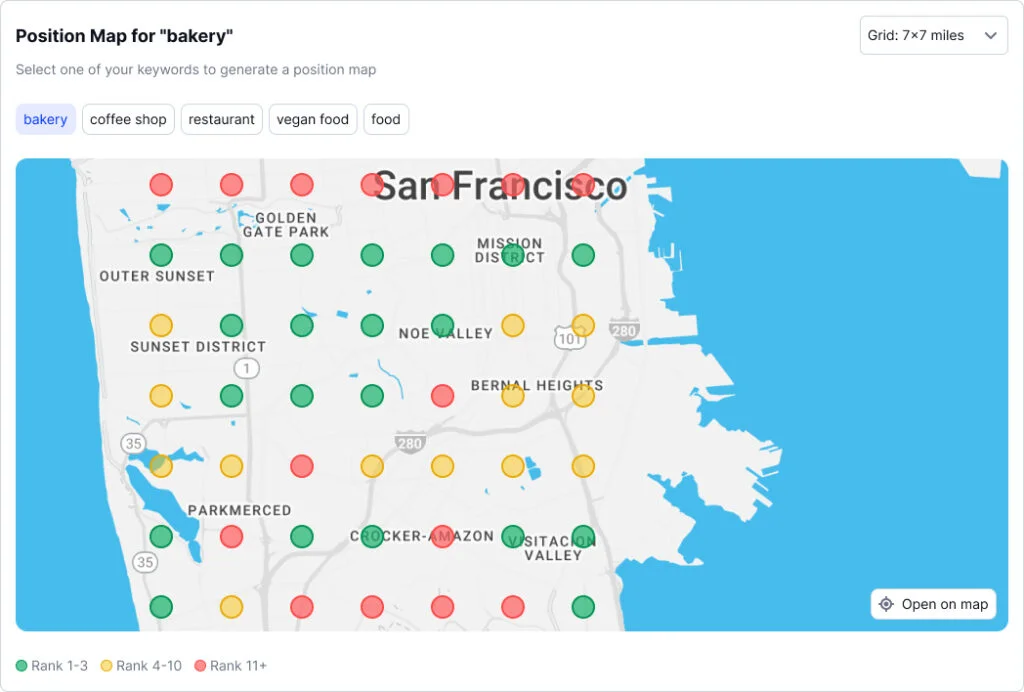
Because distance is calculated from the searcher, not from you. There is no single map pack position for your business. There's a different result for every point on the map.
This has three consequences:
Checking your Google Maps SEO by searching from your office is useless. You're standing at the point where you rank best.
Rank tracking needs a grid. Tools like Local Falcon and BrightLocal sample your position from dozens of points across an area and return a heat map. That picture — strong near the premises, fading with distance — is the real shape of your visibility.
Your address is a ranking factor you mostly can't change. A business on the edge of a city will struggle to rank in the centre, regardless of optimization. Worth knowing before you spend six months trying.
[SCREENSHOT SLOT 1] — A grid rank-tracking map, if you use Local Falcon or BrightLocal. Nothing explains proximity faster than a heat map that's green at the centre and red at the edges. If you don't have one, this section works without it.
Profile signals: 32%, and most of it is one field
Covered in depth in the Google Business Profile optimization guide, but the map-pack-specific points:
Primary category decides which races you're in. Not your position in them — whether you appear at all. Check what the current top three use for your target query and match it.
Completeness is a relevance signal. Services, products, attributes, description, hours. Empty fields can't match anything, and with AI local packs they're now inputs to a generated answer too.
Hours affect ranking, not just convenience. Businesses open at the moment of the search are more likely to rank for it. If you genuinely offer emergency callouts, your hours should say so.
Don't be marked temporarily closed. It suppresses ranking heavily, and profiles sometimes get flagged this way by Google's own automated edits. Check monthly.
Reviews: 20%, and the only prominence factor you control
Distance is fixed. Links and real-world prominence are slow. Reviews are the one substantial factor you can move deliberately this quarter.
What matters, in order:
Count relative to your competitors, not in absolute terms. Look at the current top three and aim at their range.
Recency. A profile whose newest review is from last year reads as inactive.
Velocity. Steady beats spiky. Fifteen reviews in a week after a year of silence looks like what it usually is.
Keywords in review text. Review content is indexed. A review that says "came out for an emergency boiler repair on a Sunday" contains service and urgency terms you didn't have to write. Since the Q&A panel was removed, review text is also one of the main sources AI uses to answer questions about you — so asking customers to mention the specific service is now worth more than it used to be.
Never incentivise reviews. Against Google's policies, and the penalty lands on the profile.
On-page signals: 15%, the part most local businesses skip
Your website feeds the map pack, which surprises people who think local SEO is entirely profile work.
NAP consistency. Name, address and phone identical on your site and your profile — same formatting, not just the same information.
A real location page with the address, embedded map, hours and locally-relevant content. Not a contact form on a blank page.
LocalBusiness schema on that page, matching your profile exactly.
Separate pages per service, each targeting the service plus the location. One page listing twelve services competes for none of them well.
Site speed and mobile. Local searches are overwhelmingly mobile, often on cellular networks. A slow site loses the visit after you won the ranking.
Behavioural signals: 9%, and they compound
Google watches what people do with your result: clicks, calls, direction requests, how long they stay on your site, whether they come back to search again.
You can't fake these, but you can earn them:
- Photos drive clicks and direction requests more than anything else on the profile
- A compelling primary category and name make yours the one people pick
- A fast, useful landing page stops the return-to-search that signals a bad match
This is the quiet reason photos matter. They aren't a ranking factor directly; they drive the behaviour that is one.
Links and citations: 14% combined, and badly misunderstood
Citations (6%) are mentions of your NAP on directories. The important thing is consistency, not volume. Five accurate listings beat two hundred with three different phone numbers. Get the major ones right — Apple Maps, Bing Places, Facebook, your industry's main directory — then stop.
Links (8%) matter more and are harder. Local links beat generic ones: the chamber of commerce, a local news mention, a supplier's partner page, a sponsored community event. One link from a local newspaper outweighs fifty directory profiles.
A newer finding worth acting on: inclusion in "best of" or "top local" roundups appears to help, both in traditional and AI-driven search. Getting into a "best plumbers in [city]" list is now a legitimate local SEO tactic, not just a vanity placement.
A 90-day Google Maps SEO plan
Weeks 1–2 — fix relevance Primary category checked against the current top three. Every field completed. NAP consistent across site and profile. Baseline screenshot of Performance before anything changes.
Weeks 3–6 — reviews Ask every satisfied customer, in person, at the moment they're happiest. Aim for a steady trickle, not a burst. Respond to all of them within 48 hours.
Weeks 5–8 — on-page Location page with schema. A page per service. Fix whatever PageSpeed flags on mobile.
Weeks 8–12 — prominence Three to five genuinely local links. Correct the major citations. Pitch yourself to one "best of" roundup.
Throughout — weekly post, monthly photos, monthly check for incorrect Google-suggested edits.
Expect category and field changes to show in two to four weeks. Review and link effects take two to six months. Anyone promising the map pack in thirty days is guessing or lying.
Measuring it
Performance tab — searches split by discovery versus direct, calls, direction requests, website clicks. Rising discovery searches is the signal that relevance work is landing.
Grid rank tracking — the only honest way to see position, because position varies by location.
Search Console — for the website half of the work.
Not: searching for yourself from your office. Personalised, location- biased, and flattering. It is the single most common way people convince themselves their Google Maps SEO is working.
[SCREENSHOT SLOT 2] — Performance tab showing discovery vs direct searches over 90 days. If discovery is climbing, that's your proof.
FAQ
How long does Google Maps SEO take to work? Profile and category changes: two to four weeks. Review and link effects: two to six months. Competitive urban categories take longer than rural ones.
Can I pay Google for a better map pack position? No. Google states plainly there's no way to request or pay for better local ranking. Local Services Ads and Google Ads buy you a slot above the pack — a different, clearly labelled placement.
Why do I rank in some parts of the city and not others? Distance is measured from the searcher. There's no single position — there's a different result at every point on the map.
Do I need a physical address? You need one to verify. You can hide it and show a service area instead. Service-area businesses can rank, but proximity still applies from wherever Google places you.
How many reviews do I need? Enough to be in range of the current top three. Check them rather than chasing a number.
Are citations still worth building? Accuracy yes, volume no. They're about 6% of the picture. Fix the major ones, then put the effort into reviews and local links.
What about the AI local pack? About 8% of keywords and rising. Your defence is the same work — a complete, accurate, well-reviewed profile — because the AI pack draws on the same sources. There's no separate optimization for it yet.
Where to go next
→ Google Business Profile Optimization: The Complete Guide — the pillar this article belongs to
→ How to Set Up a Google Business Profile — if you haven't claimed or verified yet