
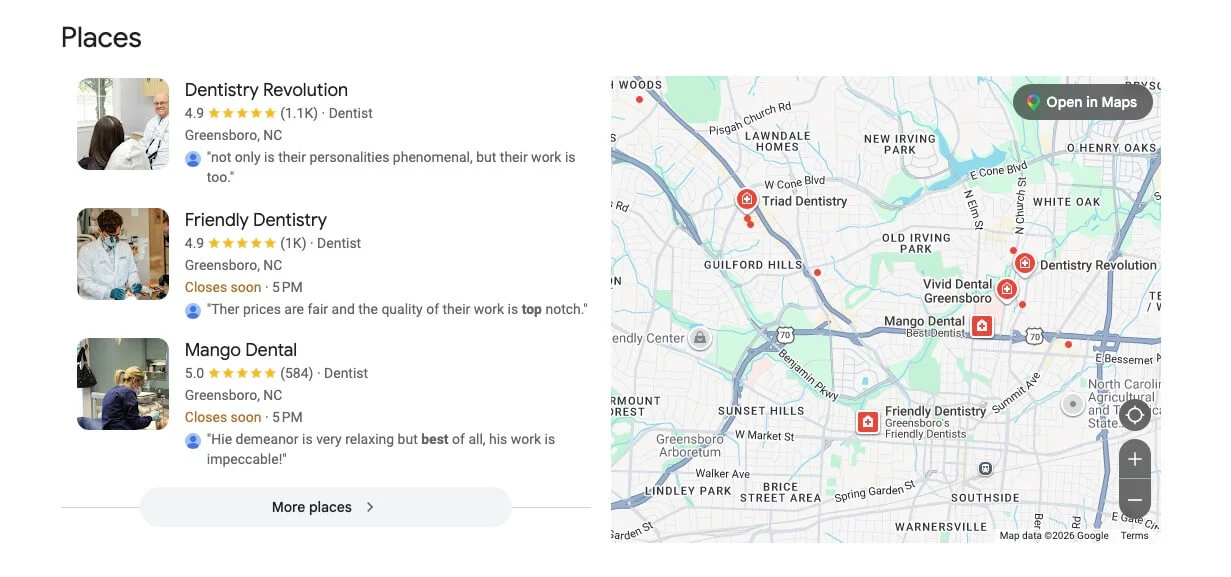
Local SEO for dentists is a proximity game before anything else
Almost nobody drives across a city for a routine check-up. Patients search "dentist near me", look at the three results on the map, and pick one. That single behaviour shapes everything about local SEO for dentists.
It also sets a hard limit. Distance is measured from the searcher, so there is no single position for your practice — you rank differently at every point on the map. A practice in one suburb will not rank in another, however good its profile is. The realistic goal is to own your catchment, not your city.
Which makes the question not "how do I rank first" but "how do I rank first everywhere a patient would plausibly travel from".
What local SEO for dentists is worth, in paid terms
Dentistry is one of the more expensive verticals on Google Ads. The 2026 benchmarks:
| Metric | Dentists | All industries |
|---|---|---|
| Cost per click | $8.00 | $5.42 |
| Conversion rate | 10.67% | 8.18% |
| Cost per lead | $72.97 | $66.69 |
Every map pack click you earn is a click you didn't pay $8 for. A practice getting 100 organic profile clicks a month is capturing roughly $800 of traffic it would otherwise have to buy — and dental converts well at 10.67%, so those clicks are worth having.
That's the honest case for doing local SEO for dentists before, or alongside, paid search.
Primary category: the biggest single lever in local SEO for dentists
The default choice is Dentist. For most practices that's correct.
The trap is the specialist categories — Cosmetic Dentist, Orthodontist, Pediatric Dentist, Dental Implants Periodontist, Emergency Dental Service. Choosing one of those as your primary narrows which searches you're eligible for. A general practice that sets "Cosmetic Dentist" as primary can quietly disappear from "dentist near me".
The rule: primary category = the search you most want to win. For most practices that's the general one. Add the specialisms as secondary categories, where they help without displacing the main signal.
How to check rather than guess: search dentist near me in an incognito
window from your area, click each of the three map pack results, and note
their primary category. If all three say Dentist and you say Cosmetic
Dentist, you've found your problem.
Keep secondaries honest and few — three or four genuine ones. Loading up on categories you don't serve is a documented suspension trigger.
Services are where most dental profiles leave visibility on the table
Google can only match you to searches for things you've actually listed. Most dental profiles list "dentistry" and stop.
List every treatment separately, each with its own short description:
- Routine check-up and hygiene
- Emergency dental appointments
- Teeth whitening
- Dental implants
- Invisalign / clear aligners
- Root canal treatment
- Crowns, bridges, veneers
- Children's dentistry
- Wisdom tooth extraction
- Dentures
Each becomes its own matchable entity. A practice listing fifteen treatments has fifteen ways to be found; one listing "dentistry" has one.
Attributes matter more in dental than most verticals, because they become filters in Maps. Wheelchair accessible, on-site parking, LGBTQ+ friendly, appointment required, online appointments, languages spoken. Each applicable attribute is a filter you survive rather than vanish from.
Reviews: the factor that separates practices
Reviews are around 20% of local pack ranking weight, and they're the one prominence signal you can deliberately move. In dentistry they do double duty — patients choosing a dentist are unusually review-driven, because the decision feels personal and slightly frightening.
Benchmark against your actual competitors, not a number. Look at the three practices currently in the map pack for your target search. If they have 90, 140 and 210 reviews and you have 15, that gap is your project.
Recency beats volume. A practice with 200 reviews, none in the last year, reads as coasting. Steady flow signals an active practice.
Ask at the right moment — after a completed treatment the patient is happy with, in person, with the link sent by text while they're still at reception. Not by email three weeks later.
Review text is now doing extra work. Since Google removed the profile Q&A panel, review content is one of the main sources the new AI answers draw on. A review saying "they fitted me in the same day with a broken crown" answers a question for a future patient that you can no longer answer yourself.
Respond to all of them within 48 hours, and be careful with the negative ones: never confirm or deny that someone is a patient, never discuss treatment. Acknowledge, apologise for the experience, move it offline. One careless reply can become a complaint about patient confidentiality.
The website half, which most practices skip
Local SEO for dentists isn't only profile work. On-page signals are roughly 15% of local pack weight.
A page per treatment, each targeting the treatment plus the location — "Dental Implants in [City]" rather than one services page listing everything.
NAP consistency. Practice name, address and phone identical on your site and your profile, formatted the same way.
LocalBusiness or Dentist schema on your contact or homepage, matching the profile exactly.
Speed and mobile. Dental searches are overwhelmingly mobile and often urgent. A slow site loses the patient after you won the ranking.
Online booking. If the map pack sends someone to your site at 9pm with toothache and the only option is "call during opening hours", you've lost them to the practice with a booking widget.
Emergency searches are the opportunity most practices ignore
"Emergency dentist near me" is high-intent, time-critical, and relatively poorly served. Patients searching it convert at unusual rates because they are in pain and choosing in minutes.
To compete for it:
- Add Emergency Dental Service as a secondary category, if you genuinely offer it
- List emergency appointments explicitly as a service
- Make your hours accurate, including any out-of-hours arrangement — businesses open at the time of the search are more likely to rank for it
- Build a dedicated emergency page with your response time stated plainly
- Answer the phone
This is the clearest case where accurate hours are a ranking factor rather than a courtesy.
A 90-day local SEO for dentists plan
Weeks 1–2. Primary category checked against the current map pack. Every treatment listed as a separate service. Attributes completed. Photos — real ones of the practice and team, not stock. Baseline screenshot of the Performance tab.
Weeks 3–8. Review generation: ask every satisfied patient, steadily. Set up the process at reception so it doesn't depend on remembering.
Weeks 5–10. Treatment pages on the website, schema, booking, mobile speed.
Weeks 8–12. Local links — a dental school, a local sponsorship, the chamber of commerce, a "best dentists in [city]" roundup.
Ongoing. Weekly post, monthly photos, respond to every review.
Expect category and field changes within two to four weeks, review-driven movement over two to six months.
[SCREENSHOT SLOT 1] — A dental profile's Performance tab, before and after, practice name blurred. If you manage a dental client, this is the most persuasive image on the page.
FAQ
How long does local SEO for dentists take? Profile and category changes show in two to four weeks. Review and prominence effects take two to six months. Competitive city centres take longer than suburbs.
How many reviews does a dental practice need? Enough to sit in range of the three practices currently in your map pack. Check them rather than chasing a round number — and keep a steady flow, since recency counts.
Should I use Cosmetic Dentist as my primary category? Only if cosmetic work is genuinely your main business. For a general practice it narrows the searches you can appear in. Use it as a secondary.
Why do I rank in some areas and not others? Proximity. Results are calculated from the searcher's location, so your visibility fades with distance. Track it with a grid tool rather than searching from the practice.
Is local SEO for dentists better than Google Ads? They do different jobs. Local SEO compounds and is free; ads are immediate and cost about $8 a click. Most practices should fix the profile first, because it makes paid traffic convert better too.
Can I reply to a negative review mentioning the treatment? No. Never confirm someone is a patient or discuss their care publicly. Acknowledge, apologise for the experience, invite them to contact the practice directly.
Where to go next
→ Google Business Profile Optimization: The Complete Guide — the pillar: every field, reviews, and what changed
→ Google Maps SEO: How to Rank in the Local Map Pack — the ranking factors behind all of this