
The short answer, then the one that's actually useful
The median cost per click across US search campaigns is $5.42, and the median cost per lead is $66.69.
That's the number everyone quotes. It's also close to useless on its own, because the real Google Ads cost depends on your industry, and the spread is six-fold. A click in arts and entertainment costs $1.63. The same click for a law firm costs $9.87.
Worse, "what do Google Ads cost" usually conflates three separate things:
- Ad spend — what you pay Google
- Management — what you pay whoever runs it
- The costs nobody quotes you — tracking, landing pages, tools, your own time
This guide covers all three, with the real numbers.
The data below comes from WordStream's 2026 benchmark study: 13,474 US search campaigns across 23 industries, April 2025 to March 2026, reported as medians. Medians matter here — averages in ad data get dragged upward by a handful of enormous accounts.
Google Ads cost by industry: the full table
| Industry | CTR | CPC | Conv. rate | Cost per lead |
|---|---|---|---|---|
| Animals & Pets | 7.49% | $4.06 | 16.22% | $31.50 |
| Apparel, Fashion & Jewelry | 6.64% | $4.44 | 4.50% | $97.51 |
| Arts & Entertainment | 12.75% | $1.63 | 5.91% | $26.84 |
| Attorneys & Legal Services | 5.87% | $9.87 | 5.55% | $131.63 |
| Automotive — For Sale | 8.28% | $2.27 | 6.01% | $44.26 |
| Automotive — Repair & Parts | 5.56% | $4.35 | 15.51% | $29.96 |
| Beauty & Personal Care | 6.75% | $4.62 | 10.35% | $39.25 |
| Business Services | 6.10% | $5.87 | 4.85% | $93.69 |
| Career & Employment | 5.88% | $5.81 | 3.05% | $67.36 |
| Dentists & Dental Services | 5.66% | $8.00 | 10.67% | $72.97 |
| Education & Instruction | 7.56% | $4.81 | 13.14% | $77.48 |
| Finance & Insurance | 9.83% | $3.39 | 2.64% | $74.44 |
| Furniture | 6.57% | $3.97 | 2.99% | $106.70 |
| Health & Fitness | 5.81% | $6.17 | 6.94% | $67.36 |
| Home & Home Improvement | 6.47% | $8.33 | 8.05% | $90.92 |
| Industrial & Commercial | 6.57% | $5.87 | 8.20% | $75.19 |
| Personal Services | 7.16% | $7.17 | 12.34% | $54.60 |
| Physicians & Surgeons | 6.61% | $4.76 | 12.43% | $40.04 |
| Real Estate | 7.61% | $3.22 | 3.70% | $102.51 |
| Restaurants & Food | 6.83% | $2.05 | 8.05% | $30.57 |
| Shopping & Gifts | 8.28% | $4.14 | 4.01% | $49.40 |
| Sports & Recreation | 8.75% | $2.77 | 7.69% | $44.26 |
| Travel | 9.32% | $2.14 | 5.83% | $44.70 |
Read the last column, not the second. Cost per click is vanity; cost per lead is what hits your bank account. Finance & Insurance has a cheap-looking $3.39 click — but a 2.64% conversion rate drags the lead cost to $74.44. Automotive repair pays more per click at $4.35 and gets leads for $29.96, because 15.51% of clicks convert.
What moved in 2026: cost per lead fell about 5%, the first decline in five years, while CPC rose about 3%. Clicks cost more; fewer were needed. Conversion rates improved in 87% of industries. Biggest drops in lead cost were travel (−39%), beauty (−35%) and physicians (−30%).
How the auction actually prices your click
Most people assume you pay what you bid. You usually don't, and understanding why is how you lower your Google Ads cost without lowering your ambitions.

Google Ads Help, "Actual cost-per-click (CPC): Definition"
Two mechanics matter.
You pay the minimum needed to beat the advertiser below you, not your maximum bid. If no one is close behind, you pay the reserve price. Your max bid is a ceiling, not a price.
Ad Rank decides position, and your bid is only part of it. Google combines your bid with auction-time ad quality — expected click-through rate, ad relevance and landing page experience — plus context and the competitiveness of the auction.
The consequence is the single most useful fact about Google Ads pricing: improving quality lowers your cost per click at the same position. Two advertisers in the same slot can pay very different amounts. The one with tighter ad groups, more relevant ads and a faster, better-matched landing page pays less.
That's why ad group structure isn't housekeeping. It's a discount.
Working out your Google Ads cost from leads, not guesswork
Work backwards from leads, not forwards from what you feel like spending.
Step 1 — find your cost per lead in the table above.
Step 2 — decide how many leads you need per month. Be realistic: if you close 1 in 4 and want 5 new customers, that's 20 leads.
Step 3 — multiply. A dentist wanting 20 leads at $72.97 needs about $1,460/month in ad spend.
Step 4 — sanity-check against the learning threshold. Automated bidding needs roughly 30 conversions a month to work well. Below that it's guessing with your money. If 30 conversions costs more than you can spend, don't give up — narrow the targeting. Fewer keywords, tighter locations, restricted hours. A small budget concentrated beats a small budget spread.
Step 5 — convert to a daily budget. Divide monthly by 30.4, not 30. That's the multiplier Google uses for your monthly charging limit. $1,460 ÷ 30.4 = $48/day.
Bear in mind daily spend can run to twice your daily budget on a busy day; the monthly cap is what holds. That's covered in the Google Ads for small business guide.
Management fees: the second half of your Google Ads cost
Management is separate from ad spend, and the models differ more than the prices.
Percentage of spend — typically 10–20% of monthly media spend, often with a minimum. Simple, but the incentive points the wrong way: the agency earns more when you spend more, regardless of return. Ask for a cap or a tiered rate.
Flat monthly fee — predictable, and the incentive is neutral. The risk is scope: a low flat fee can quietly exclude conversion tracking checks, landing page feedback or anything beyond the basics.
Hybrid — a base fee plus a smaller percentage above a threshold. Common, and usually the fairest structure for both sides.
Performance-based — be careful. "Free unless we perform" is paid for somewhere, and the definition of performance is often raw lead volume, which is easy to inflate with low-quality traffic.
Hourly consulting — roughly $75–250+/hour for audits, training or strategy rather than ongoing management.
Rough planning ranges:
| Monthly ad spend | Typical management fee |
|---|---|
| $1,000 – $5,000 | $500 – $2,000 |
| $5,000 – $25,000 | $1,500 – $5,000 |
| $25,000 – $100,000 | $4,000 – $12,000 |
Treat these as orientation, not quotes — and note they come from agency marketing material, which has an obvious interest in the ranges it publishes.
What should make you walk away: no conversion tracking review, no search terms review, no negative keyword plan, reporting that shows only clicks and impressions, or refusing you admin access to your own account. That last one is non-negotiable. The account should be yours.
The Google Ads costs nobody quotes you
This is where a Google Ads cost estimate quietly breaks.
Conversion tracking setup. Non-negotiable, and if you can't do it yourself it's a real cost. Running ads without it wastes far more than setting it up.
Landing pages. The highest-leverage spend in the whole exercise and the most commonly skipped. Sending paid traffic to a homepage is how accounts with decent click costs still produce expensive leads.
Your time. Weekly search terms review, negative keywords, responding to leads. Call it two to four hours a month minimum. That's a real cost even though no invoice arrives.
The learning period. Your first 30–60 days will underperform. Budget for it rather than panicking in week two and restarting, which resets the learning and wastes what you already spent.
Lead response. Ads generate enquiries; enquiries decay fast. A lead you paid $70 for and answer two days later is money set on fire.
Seven ways to lower what you pay
- Improve Quality Score. Tighter ad groups, closer ad-to-keyword match, faster and more relevant landing pages. This lowers cost per click at the same position — the only lever that reduces price rather than volume.
- Negative keywords, weekly. The most direct cut to wasted spend.
- Exact and phrase match while learning. Broad match is cheaper per click and more expensive per lead until the system has data.
- Dayparting. If nobody answers the phone at 2am, don't pay for 2am clicks.
- Tighten geography. Cut the radius where you never convert.
- Fix conversion rate, not just cost per click. Doubling conversion rate halves cost per lead — usually easier than halving CPC.
- Check whether you need to bid on your own brand. If you rank first organically and no competitor bids on your name, you may be buying clicks you already had.
FAQ
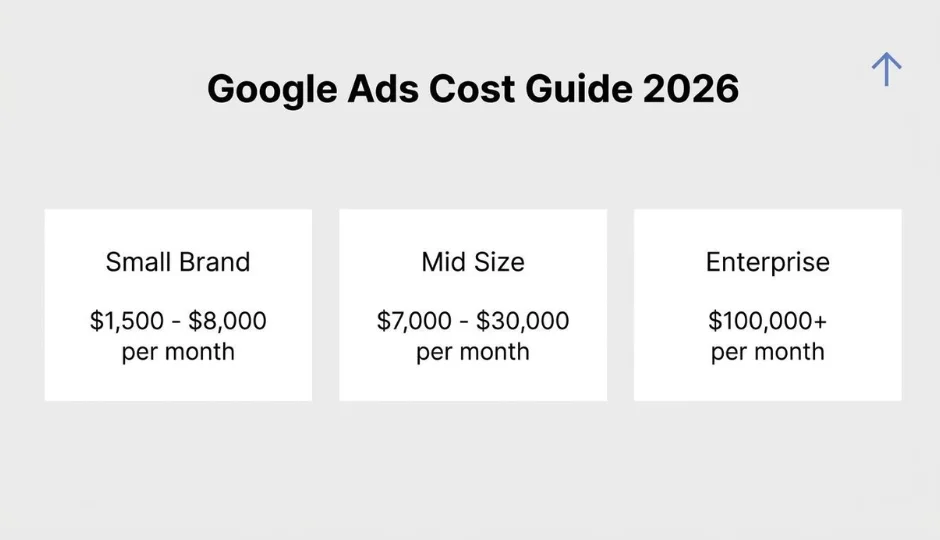
How much do Google Ads cost per month for a small business? Most small businesses land between $1,000 and $3,000/month in ad spend. Work it out from your industry's cost per lead and how many leads you need — and check you can reach ~30 conversions a month so bidding can learn.
What's a good cost per click? There is no single good Google Ads cost per click in the abstract. $9 is fine for a law firm and terrible for a restaurant. Compare against your industry row, then against your own trend.
Do Google Ads have a minimum spend? No minimum from Google. The practical floor is whatever generates enough conversion data to optimise — usually $500–1,000/month.
Why is my CPC higher than the benchmark? Competition, Quality Score, location and the specific keywords. High-intent commercial terms cost far more than informational ones. Check your Quality Score first — it's the part you control.
Is Google Ads cheaper than Facebook Ads? Facebook clicks are usually cheaper. Google clicks usually convert better, because the person is actively searching. Compare cost per customer, not cost per click.
Do I pay for impressions? Not on standard search campaigns — you pay per click. Some campaign types bill per impression or per view.
Does Google Ads cost more in competitive industries? Yes, substantially. Legal, insurance and home improvement are among the most expensive because a single customer is worth a great deal.
Where to go next
→ Google Ads for Small Business: The Complete Guide — the pillar this belongs to: structure, tracking and the AI shift
→ Google Business Profile Optimization — if the numbers above don't work for you, the free alternative